
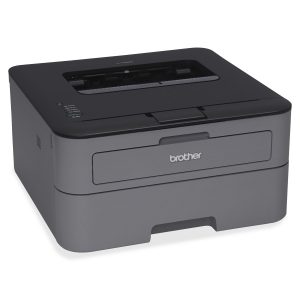
We’ve all heard about laser printers, but how many of us have any idea how they work? Sure, the name lets you in on the fact that lasers are involved, to most that sounds kind of space age though.
In this article we’re going to take some of the mystery out of how laser printers work.
Who Came up with These Things?
You might be surprised to hear that the first laser printers were actually just modified photocopiers. The actual process of dry printing was developed by an American physicist and inventor, Chester Carlson. He successfully patented the idea in 1942, setting the foundation for laser printing.
After years of looking for a larger manufacturer to express interest in the technology, Carlson managed to negotiate a commercial rights deal with the Haloid Company. That company that would later rebrand to Xerox.
So How Does It Work?
There is quite a bit going on every time you print out a document. But the broad strokes of it can be set out simply enough.
When you click print, you’re sending millions of bytes of data to your laser printer. These ones and zeros are read by a smaller computer inside the printer. When it’s ready, the little computer switches on something called a corona wire, a high-voltage wire that gives everything nearby a static charge. This static electrical charge is the core principle at work throughout the whole printer.
Something called a photoreceptor drum, an object that looks like a smooth metal rolling pin, takes on a positive charge evenly across its whole surface. Directed by a mirror, the laser draws precise areas of negative charge onto the photoreceptor drum. Leaving other areas on the drum positively charged. These patterns of positive and negative charge are the shapes that later become the characters and shapes printed on the page.
A roller distributes negatively charged toner (actually a very fine dust at this point) onto the photoreceptor drum. The negatively charged toner only sticks to the parts of the drum that are positively charged, you might remember from science class that opposite poles attract.
The paper you have in the hopper is taken up and given its own, much stronger, negative charge. This negative charge is enough to draw the toner down off the photoreceptor drum onto the page. That page then passes through two hot rollers that put enough heat through the paper to melt the toner into the fibres of the page.
Buy Cheap Printer Cartridges Online with Toner City
We hope you’ve enjoyed getting a bit of insight into what is going on each time you print something with your laser printer. At Toner City, we have spent the time to understand our products and how to get the best out of them. With over 10 years in the market, we have the experience, knowledge and buying power to give our customers access to great quality products at low prices.
Look to Toner City here online for the best of the best, at a price that won’t break the budget.