
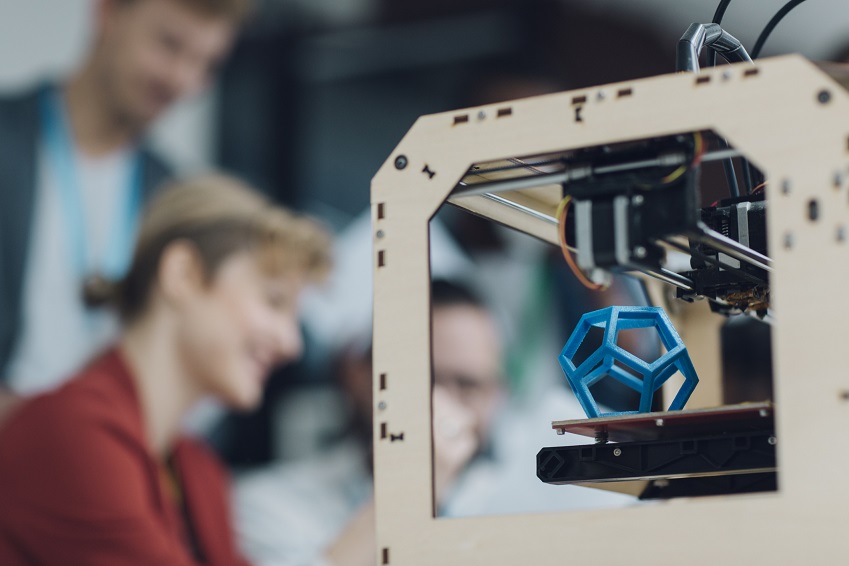
3D printing is the most innovative technology to have ever hit the printing industry in the past few decades. The first 3D printing experiments were done on 3D printing dating back to 1981 in Japan, however, it wasn’t patented until 1986 by Charles Hull and the first item ever to be printed was a small cup. Although it’s supposedly been around for a long time, 3D printing still has a long way to go before it truly takes off. There are many costs and obstacles that need to be overcome before it becomes common practice in our world.
What is 3D printing?
The process of 3D printing refers to the creation of three dimensional objects from a digital computer design. 3D printers work using an additive process which involves layers and layers of materials being laid down until the 3D object is made. It is a quick process compared to manufacturing and allows for complex designs to come to life.
The process of 3D printing
The first thing you need is a digital 3D model which you can either create from scratch with specialised software or download it from a 3D library. The next step is to slice up the model in hundreds if not thousands of layers for the device to be able to print layer by layer. This is done with a slicing program.
3D Printing Applications
You’ll be surprised how versatile 3D printing technology is as you can create almost anything with a 3D printer. It has been used in the following applications:
- Dental products
- Movie props
- Fossil reconstruction
- Evidence reconstruction in forensic pathology
- Prosthetics
- Industrial products
- Consumer products – footwear, eyewear, jewelry
- Ancient artefact replication
- Architectural scale models
- Aviation accessories
- Automotive parts, tools, and fixtures
- Building construction
- Healthcare – implants
- Food
- Bio-printing
- Education
Advantages of 3D printing
The concept of 3D printing solves many of the issues that automation does which is why it has the most value to offer in the manufacturing industry. While there may be some benefits of 3D printing related to personal use as well, most of the mentioned advantages will be relating to manufacturing and large scale 3D printers. Here are the main advantages of 3D printing:
- Cheaper to create complex objects
- Faster than human processes
- Customised manufacturing becomes easier
- No assembly required
- Doesn’t require great skill
- No lead time between design and prototype manufacturing
Although 3D printing technology offers numerous benefits, it still comes with its flaws. The process will require more refining before it is commonly adopted and used in our everyday processes.
FAQs
Does 3D printing require cartridges?
No, 3D printing does not use cartridges.
How much is a 3D printer cartridge?
You can shop for a 3D printer cartridge for around $25-30 in Australia.
What kind of ink do 3D printers use?
3D printing requires the use of filaments, thermoplastics or powdery metals to create 3D objects. They don’t use liquid ink like traditional printing methods do.